
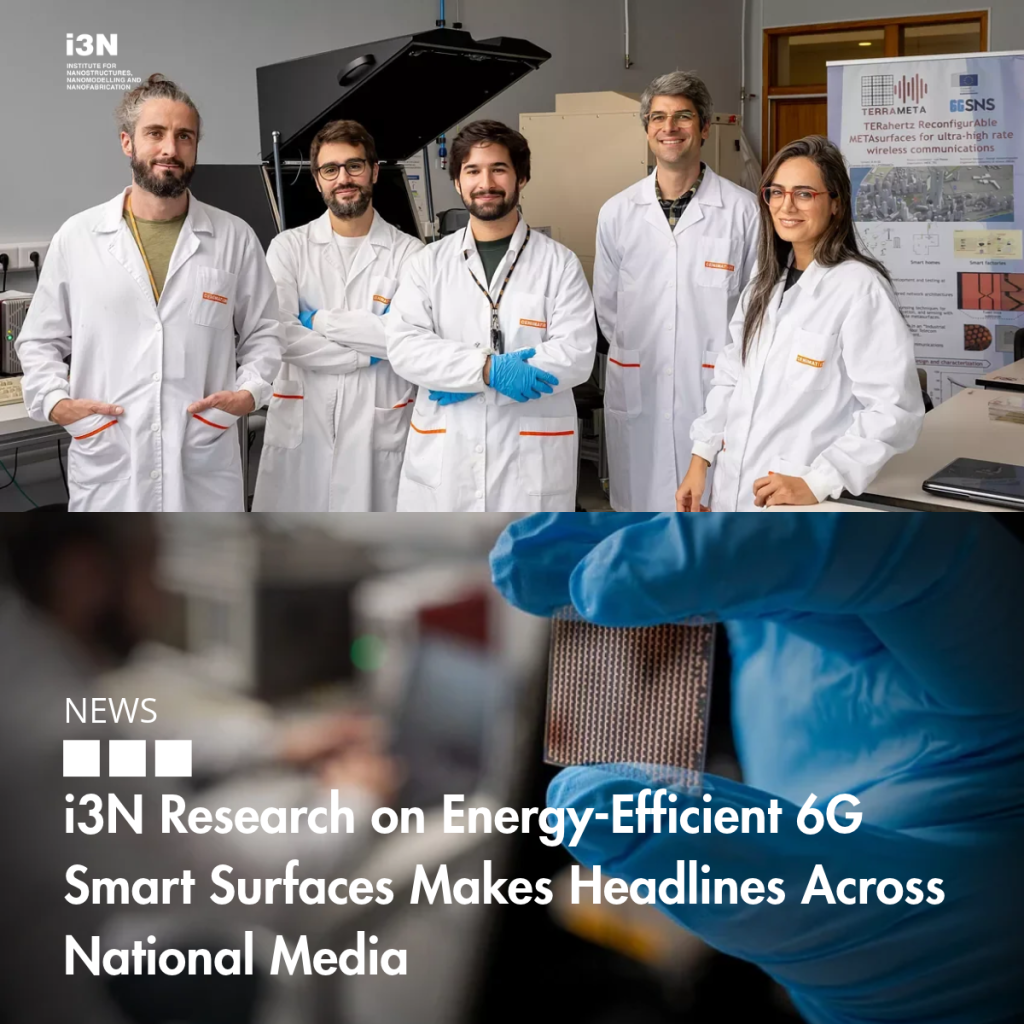
Research carried out at CENIMAT|i3N has recently gained widespread attention across Portuguese media for its contribution to the future of 6G wireless communications – a technology expected to reach commercial deployment by 2030 with ultra-low latency and speeds dozens of times faster than current 5G networks.
The breakthrough was spotlighted by outlets such as Forbes Portugal, SAPO Tek, Executive Digest, PC Guia, Green Savers, SAPO, and NetThings, highlighting the role of i3N researchers in designing low-power hardware for next-generation telecommunications.
At the core of this innovation is a 24 × 24-element Reconfigurable Intelligent Surface (RIS) controlled by memristors, co-developed within the European project Terrameta. The research team is coordinated by Professor Asal Kiazadeh and includes Dr. Jonas Deuermeier, Dr. Adam Kelly, PhD Student Tomás Mingates, and Dr. Jorge Martins, working alongside national and international partners INESC TEC, Instituto de Telecomunicações (IT), the University of Hertfordshire (UK), and CEA (France).
Unlike conventional wireless infrastructures that rely solely on direct signal transmission – and often suffer from physical obstacles and high energy demands – the RIS prototype acts as an intelligent, programmable reflector for high-frequency radio waves. By electronically steering signals toward targeted receivers, the surface transforms the surrounding physical environment into an active component of the communication network.
A key differentiator brought by the i3N team’s expertise in advanced electronic devices is the integration of memristors. Because these non-volatile components retain their programmed state without requiring a continuous power supply, the smart surface can maintain its configuration with minimal energy consumption – solving one of the major sustainability challenges facing future 6G deployments in smart factories, autonomous robotics, and connected cities.
“RIS technology allows the wireless environment itself to become an active part of the communication system. By electronically controlling how radio waves are reflected, these smart surfaces can redirect signals to the intended receivers, helping overcome obstacles and improve wireless connectivity. Combined with memristor technology, this approach opens new possibilities for low-power, intelligent, and reconfigurable wireless systems for 6G,” explains Asal Kiazadeh, Principal Investigator at CENIMAT|i3N.
This broad media coverage underscores the growing societal and industrial impact of i3N’s research in bridging functional nanomaterials and low-power nanoelectronics with the telecommunications infrastructure of tomorrow.

 Campus da FCT Quinta da Torre Campus de Santiago - Universidade de Aveiro
 (+351) 21 294 8562 (Lisboa)
 cenimat.secretariado@fct.unl.pt i3n.aveiro@ua.pt