
The PetBionic project, co-funded by COMPETE 2030 and featuring the participation of the i3N-Aveiro, is set to transform the lives of companion animals with severe injuries. The initiative aims to develop scalable, marketable, and optimized bionic prosthetics that go far beyond traditional implants.
Advancing Veterinary Science through Technology
The PetBionic project aspires to achieve a significant breakthrough in veterinary prosthetics by proposing the development of standardized, scalable, and commercially viable bionic limbs. The core innovation lies in the use of therapeutic coatings to optimize osseointegration, combined with the integration of sensors for real-time monitoring of biometric parameters—such as implant stability and bone density—using Artificial Intelligence for data analysis.
A Multidisciplinary Consortium
The project is the result of a diverse consortium bringing together crucial expertise:
- Hospital Veterinário de S. Bento (HVSB): Consortium leader, providing the medical and surgical expertise to ensure clinical relevance.
- University of Aveiro (UA): Leading the fundamental research on materials and bone interaction.
- Composites Kingdom (CK): Specializing in composite materials and additive manufacturing to optimize implant weight and durability.
The Role of i3N and UA
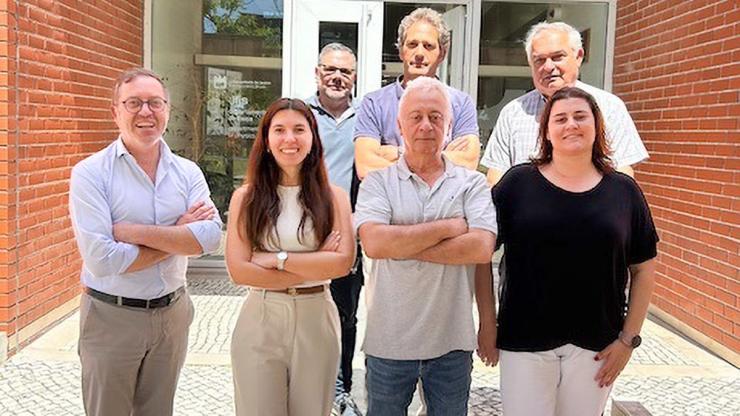
The initial phase of the project, dedicated to researching materials and their interaction with bone tissue, is led by Manuel Graça at the University of Aveiro. The team includes researchers Sílvia Soreto, Manuel Valente, Luís Cadillon, and Jorge Monteiro from the Institute of Nanostructures, Nanomodelling and Nanofabrication (i3N-FSCOSD) and the Department of Physics.
This research focuses on the study of:
- New alloys, ceramics, and polymers.
- Nanotechnology-based materials.
- Osteoinductive coatings (promoting the differentiation of osteoblasts, the cells responsible for bone formation).
- Antibacterial surface treatments.
A "One Health" Vision
Beyond overcoming current mechanical limitations by establishing an innovative connection between living tissue and prosthetic components, PetBionic embraces the One Health concept. The innovations developed for animals are expected to be eventually adapted for Human Medicine, illustrating the interconnectedness of human health, animal health, and environmental well-being.
Project Details
- Timeline: January 2025 – December 2027 (36 months).
- Funding: Supported by the Innovation and Digital Transition Program and the Lisbon Regional Program (Research and Technological Development Incentive System).
- Investment: Total eligible investment of €1,618,433.44, with a ERDF (FEDER) incentive of €1,055,424.38.
More information: https://www.ua.pt/pt/projetos-id/1478