
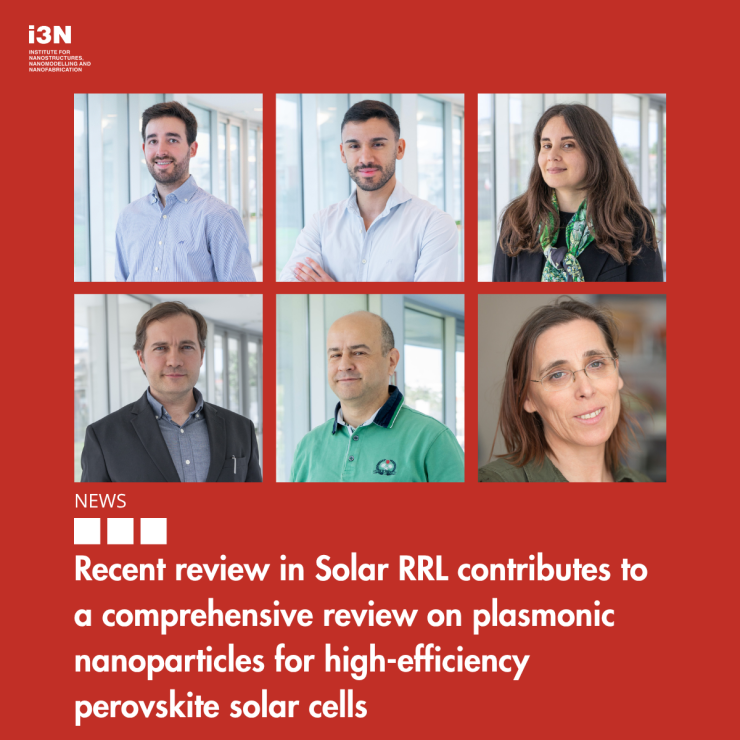
The work stems from the PhD research of Diogo Carvalho, supervised by Maria Rosário P. Correia (i3N) and Paulo Fernandes (i3N and NOA-INL).
Perovskite solar cells are at the forefront of next-generation photovoltaics, delivering impressive efficiencies. But key optical losses, particularly in the near-infrared, still hold them back from reaching their full potential.
This article provides an overview of how plasmonic nanoparticles can unlock new levels of performance by boosting light absorption and optimizing charge-carrier dynamics.
Bringing together insights from advanced analytical and numerical studies, the review reveals the fundamental mechanisms underlying plasmon-enhanced PSCs. It examines how nanoparticle properties, such as material, size, shape, distribution, and the embedding layer, directly impact device efficiency.
A critical challenge of translating theoretical advances into real-world applications, offering clear design guidelines and future perspectives for developing high-performance, plasmonic-enhanced solar technologies, is also addressed.