
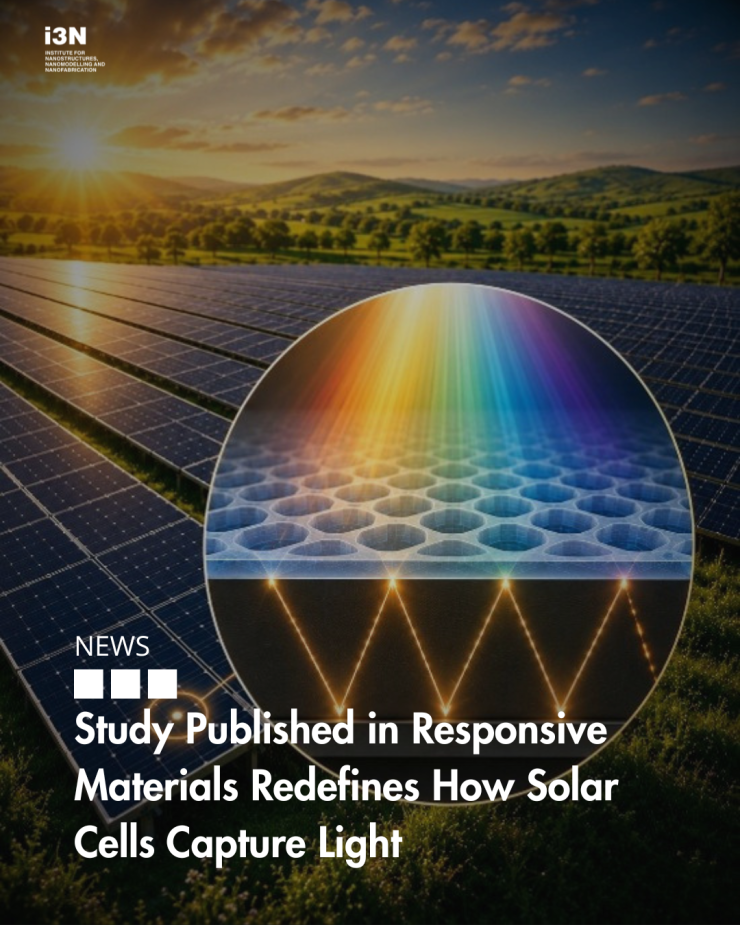
What if a solar cell’s ability to capture light wasn’t fixed by the material itself, but was something you could actively design? That’s the question at the center of a new study by the MEON group at CENIMAT|i3N, published in Responsive Materials, a leading journal in materials science.
Led by Ivan Santos under the supervision of Professor Manuel Mendes and the co-supervision of Professor Hugo Águas, and developed in collaboration with the University of York and ISC Konstanz, the work shows how photonics, optoelectronic modelling, and light-trapping architectures can be combined to control how light enters, moves through, and is absorbed inside a photovoltaic device.
The study also benefited from key contributions from Miguel Alexandre, António Vicente, Tiago Mateus, Mónica Dyreby, Eva Almeida, and Tomás Calmeiro.
Read the full article here.

 Campus da FCT Quinta da Torre Campus de Santiago - Universidade de Aveiro
 (+351) 21 294 8562 (Lisboa)
 cenimat.secretariado@fct.unl.pt i3n.aveiro@ua.pt